Imagine walking into a massive supermarket. You don't try to buy every single item on every shelf. You go to the specific aisle that has the ingredients for the meal you want to cook. A chef specializing in Italian cuisine doesn't need to master every ingredient in the Asian aisle—they develop deep expertise in their chosen domain.
Trading is exactly the same. The "Financial Market" is just the supermarket. Inside, there are distinct aisles known as Asset Classes. Each one has its own rules, its own major players, its own volatility patterns, and its own distinct "personality." What works in one market may fail spectacularly in another.
Many beginners fail because they try to trade Crypto with a Forex mindset, or trade Stocks with a Crypto mindset. They assume all markets behave the same way because they all have charts that go up and down. This is a fatal error. The underlying mechanics, the participants, the reaction to news, and the volatility profiles are fundamentally different. To survive and thrive, you must understand the terrain before stepping onto the battlefield.
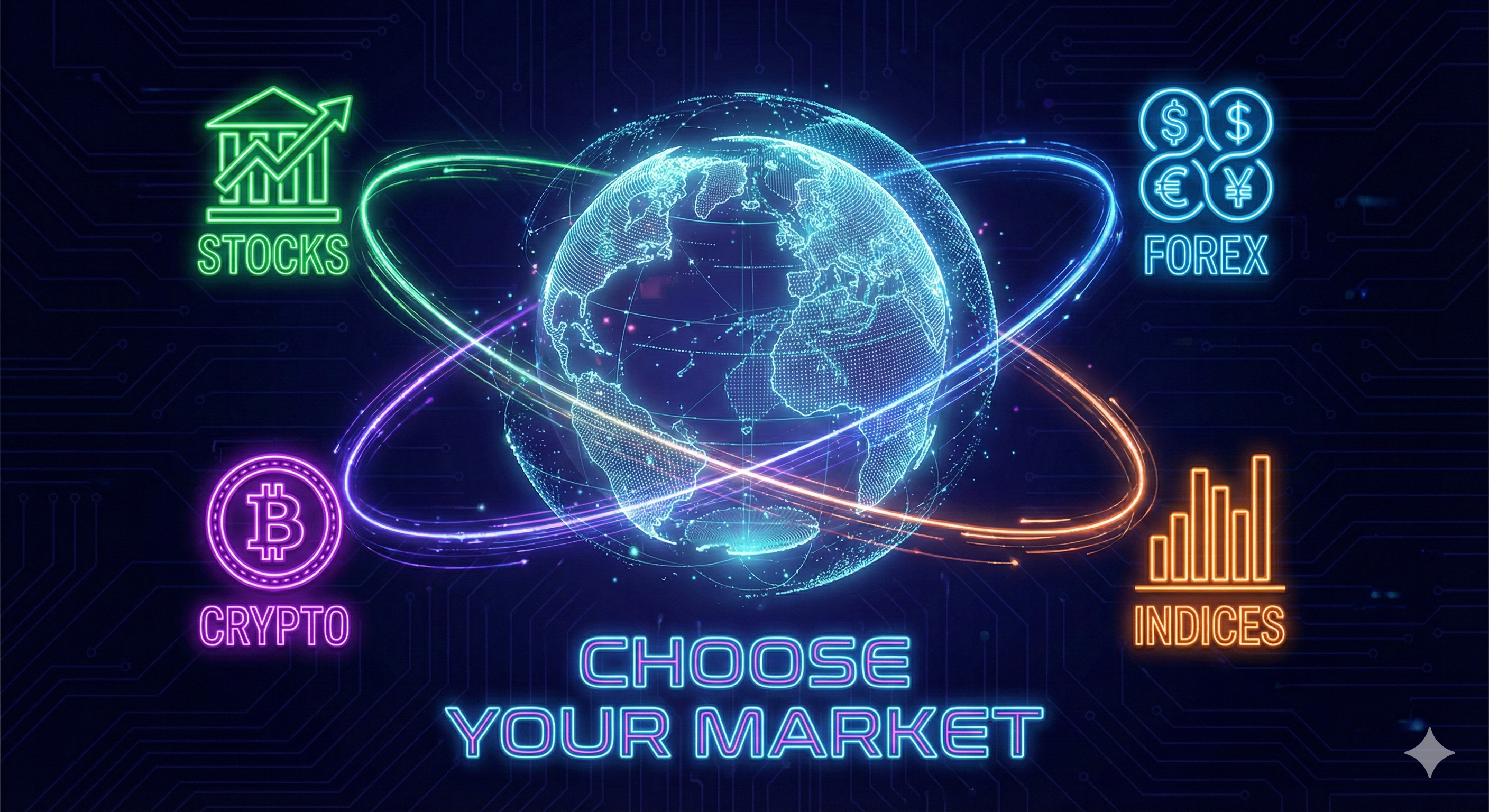
1. Stocks (Equities)
Examples: Apple (AAPL), Tesla (TSLA), Nvidia (NVDA).
When you trade stocks, you are participating in the ownership of a specific company. Unlike other markets that are driven by macro-economics, individual stocks are driven by Micro-Economics: the performance of that specific business.
The Personality: "Narrative Driven"
Stocks love a story. A new iPhone launch, a CEO scandal, or an earnings beat can send a stock flying or crashing 20% in a single day. It is emotional and news-sensitive.
- Pros: Massive volatility on specific catalysts like earnings reports, product announcements, or management changes. Easier to research and understand (everyone knows what Apple or Tesla does). Abundant news coverage and analyst opinions to help form directional views.
- Cons: The dreaded "Gap Risk." If bad news happens overnight while the market is closed, the price can open significantly lower the next morning, skipping right past your stop loss. Your $5 risk can become a $25 loss because the market simply opened below your exit level.
- Hours: Limited to exchange hours (e.g., 9:30 AM - 4:00 PM EST for US markets). Pre-market and after-hours trading exist but have lower liquidity and wider spreads.
2. Indices
Examples: S&P 500 (ES/SPX), Nasdaq 100 (NQ/NDX), DAX 40.
An index is a basket of stocks. When you trade the S&P 500, you are trading the weighted average performance of the top 500 US companies. You are not betting on one company; you are betting on the Economy.
The Personality: "Technical & Smooth"
Indices smooth out the noise. If one company crashes but the other 499 do well, the index stays stable. This makes indices the favorite playground for technical traders who hate random news shocks.
- Pros: Highly liquid—you can trade massive positions without moving the market. Respects technical analysis (Support/Resistance levels, trendlines) very well because the smoothing effect removes random noise. Less prone to manipulation since no single player can control 500 companies at once.
- Cons: Can be "choppy" (move sideways without clear direction) during low-volume periods like lunch hours or while waiting for major economic data releases like FOMC announcements.
- Hours: Almost 24/5 via Futures markets (ES, NQ). The CME Globex session runs nearly around the clock, with only brief maintenance breaks.
3. Forex (Currencies)
Examples: EUR/USD, GBP/JPY, USD/CAD.
Forex is the trading of national currencies against one another. It is the largest market in the world, with over $6 Trillion traded daily. It is not driven by company earnings, but by Central Banks and Geopolitics.
The Personality: "The Macro Grinder"
Forex moves slowly compared to crypto. A 1% move is a huge day. Traders use Leverage to amplify these small moves. It is a game of interest rates and national stability.
- Pros: Infinite liquidity (you can trade millions instantly). Open 24/5. Trends can last for months.
- Cons: High leverage can be dangerous. Trading is dominated by algorithms and banks, making it tough for beginners.
4. Crypto
Examples: Bitcoin (BTC), Ethereum (ETH), Solana (SOL).
The "Wild West" of finance. A new asset class that exists purely on the blockchain. Unlike stocks or fiat currencies, it is not controlled by any government or central bank.
The Personality: "Adrenaline & 24/7"
Crypto is bipolar. It can do nothing for weeks, then explode 50% in a day. It never closes, meaning you can wake up liquidated if you don't manage risk.
- Pros: 24/7 market (great for those with day jobs). Extreme volatility equals extreme opportunity.
- Cons: Extreme risk. Exchanges can be hacked. Assets can go to zero. No "circuit breakers" to stop a crash.
How to Choose Your Battlefield?
A sniper doesn't use a shotgun. A race car driver doesn't ride a bicycle. A trader doesn't trade every market. You need to pick the one that fits your personality, your schedule, and your risk tolerance—then master it before even considering adding another.
Trade Indices If:
You like structure, clean technical analysis, and predictable trading hours. Ideal if you want to trade during US/EU business hours and appreciate the smoothing effect of basket assets.
Trade Crypto If:
You crave volatility, understand blockchain technology, and want the freedom to trade on weekends, evenings, or whenever opportunity strikes. Be prepared for wild swings.
In the following chapters, we'll dive deep into each of these markets. You'll learn the specific risks, the best practices, and the nuances that separate profitable traders from the casualties. Start with the market that calls to you—but read about all of them to understand the broader ecosystem.