When you trade a stock (like Tesla or Apple), you are not just betting on a ticker symbol. You are betting on a living, breathing business with thousands of employees, ambitious or incompetent CEOs, pending lawsuits, upcoming product launches, and quarterly earnings that can surprise in either direction. Each stock is a story, and stories can twist in unexpected ways.
Unlike Forex or Crypto, the stock market closes. Every day at 4:00 PM EST, the New York Stock Exchange rings its closing bell, and trading stops. The charts freeze. And that is where the danger lies. Many beginners treat stocks like crypto, assuming they can exit their position anytime they want. They cannot. When the market is closed, you are locked in—and news doesn't stop just because traders have gone home.
1. The Silent Killer: "Gaps"
This is the single biggest risk in stock trading.
Imagine you buy a stock at $100 at 3:55 PM. You place a Stop Loss at $95 to limit your risk to $5 per share. You feel safe.
At 4:00 PM, the market closes. You go to dinner. At 6:00 PM, the company announces the CEO has been arrested for fraud. The sentiment crashes.
The next morning at 9:30 AM, the market opens. But it doesn't open at $100. It doesn't even open at $95. It opens at $80.
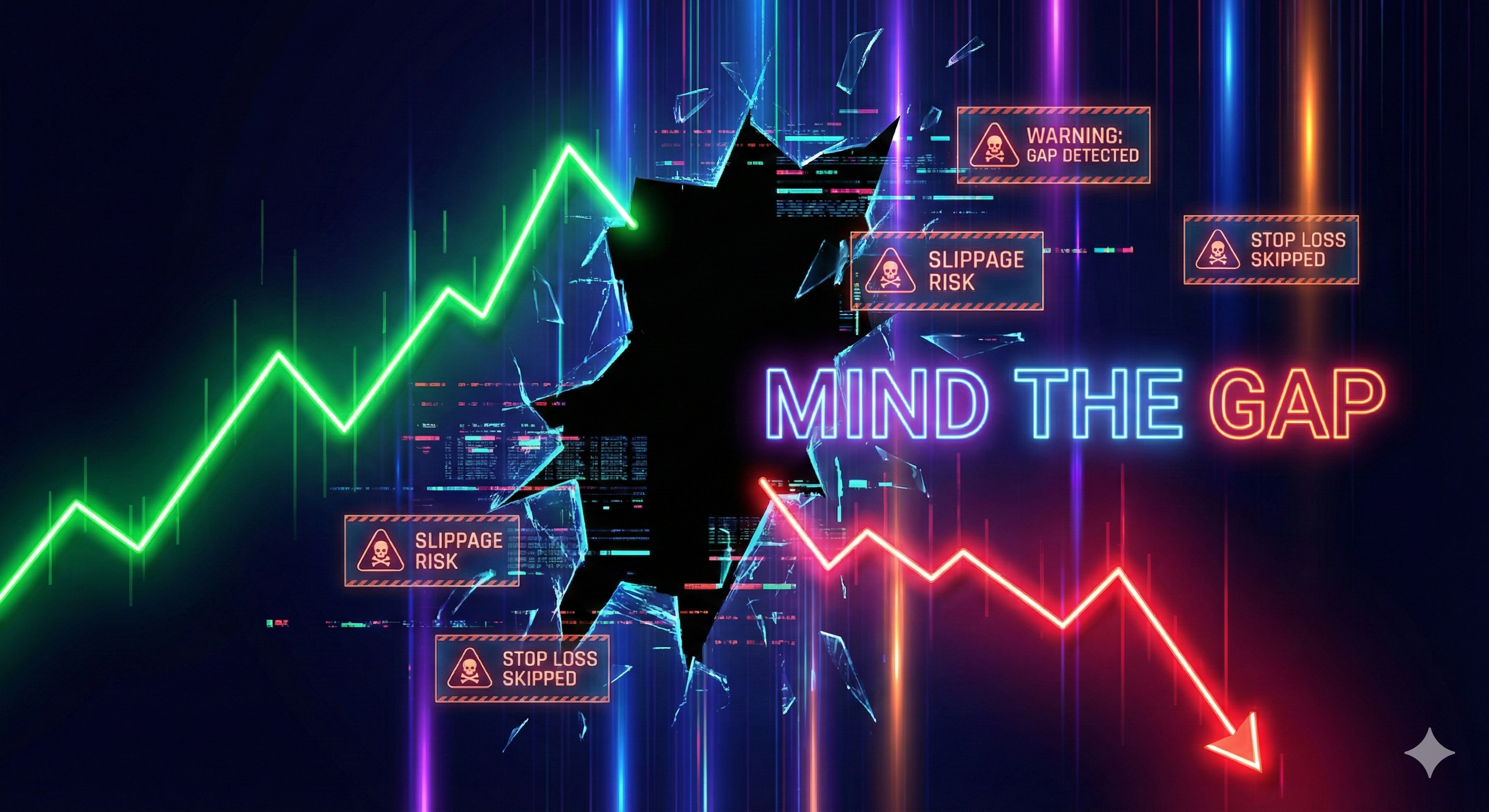
The Reality: In stocks, your Stop Loss does not guarantee an exit price. It only triggers a market order once the market is open. If the market opens below your stop, you are filled at whatever the current price is—not your intended exit. This is called Slippage, and it can be devastating.
This is why professional stock traders either: (1) close all positions before market close to avoid overnight risk entirely, or (2) size their positions assuming the worst-case gap scenario and accept that risk as part of the trade. Never assume your stop loss is a guaranteed exit in the stock market.
2. Catalyst Events (Earnings)
Four times a year, public companies release their financial results (Earnings Reports). These are scheduled events that can move a stock 10%, 20%, or even 50% in a single after-hours session. Trading through earnings without understanding the risks is basically gambling with extra steps.
- The Trap: Even if a company reports "Good Numbers" (beat on revenue and earnings per share), the stock might drop 10% because the "Guidance" (future outlook) was weak or because expectations were already priced in. Markets are forward-looking—they care about what's next, not what just happened.
- The IV Crush: If you trade Options during earnings, implied volatility pricing collapses immediately after the event, often making you lose money even if you correctly guessed the direction. The option you bought for $5 might be worth $2 the next morning even though the stock moved your way.
- The Rule: Professional traders often close their positions before earnings reports to avoid the coin-flip risk. They treat earnings as a reset point—get out, let the chaos happen, then re-evaluate once the dust settles.
3. Volume & Liquidity
Not all stocks are created equal. You must choose your vehicle carefully.
Large Caps (The Giants)
Apple, Microsoft, Amazon.
High liquidity. Tight spreads (cheap to trade). Hard to manipulate. Respect technical levels like Support & Resistance.
Small Caps / Penny Stocks
Unknown companies < $5.
Low liquidity. Huge spreads. Easy to manipulate ("Pump and Dump"). Dangerous for beginners.
At The Traders' Light, we recommend sticking to highly liquid Large Caps. Don't look for the "next hidden gem." Look for liquidity.
4. Sector Rotation
Money in the stock market flows like water. It moves from one bucket to another based on the economic cycle.
- Tech (Growth): Booms when interest rates are low (Risk On).
- Energy/Banks (Value): Booms when inflation/rates are high.
- Utilities (Defensive): Safe havens when a recession is feared (Risk Off).
A good stock trader watches where the money is flowing, not just individual charts. If Tech is weak, buying Apple is swimming upstream.
Summary
Trading individual stocks offers incredible opportunities for massive gains—look at the legendary runs of Nvidia, Tesla, or any number of momentum names that delivered 10x returns to early believers. The stock market is where fortunes are made and stories are written.
However, stock trading requires you to respect the unique risks of this market: the corporate calendar (know when earnings are coming), the gap risk (never assume your stop loss is guaranteed), the sector rotation dynamics (swim with the money flow, not against it), and the liquidity requirements (stick to large caps unless you know exactly what you're doing).
If you want exposure to the equity markets but hate the risk of a single CEO scandal or one bad earnings report ruining your carefully planned trade, there is a better way: Indices. Same market, but with the individual company risk smoothed away.