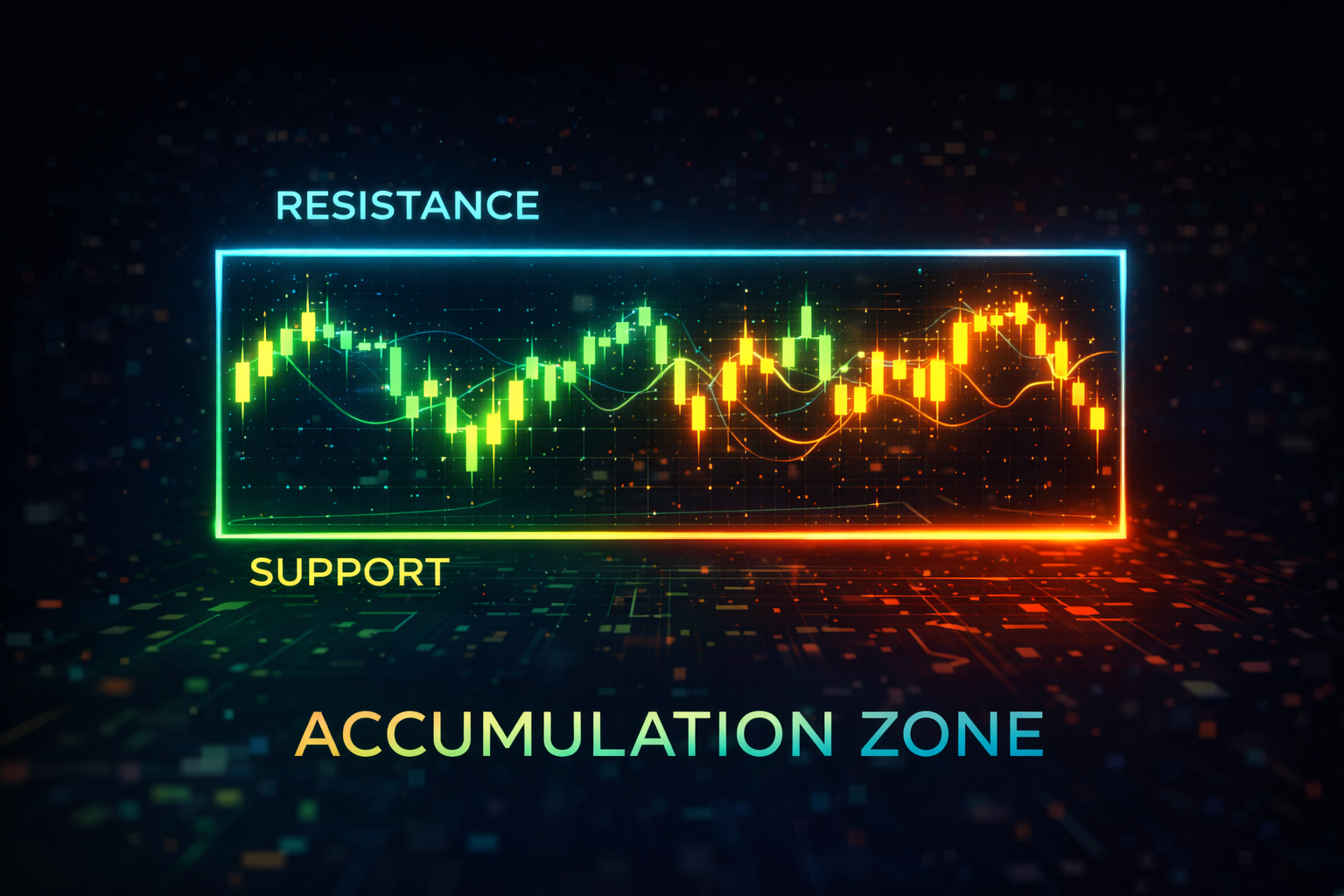
A Range Market (or Consolidation) occurs when the forces of Supply and Demand are in equilibrium. Neither buyers nor sellers have the strength to push the price decisively in one direction. The price bounces between a clear High (Resistance) and a clear Low (Support) like a ping-pong ball trapped in a box.
Ranges are not "bad markets." They are simply Balanced Markets—periods where the market is making a decision about where to go next. They are the phases where Smart Money quietly builds their massive positions, accumulating or distributing shares without moving the price significantly. The problem is not the range itself; the problem is traders trying to use Trend-following strategies in a Range environment. It's like trying to surf on a calm lake—you'll just sit there, burning time and capital, waiting for a wave that never comes.
Understanding ranges is critical because the market spends the majority of its time in consolidation. Some estimates suggest markets trend only 20-30% of the time. If you can only trade trends, you'll be frustrated 70-80% of the time. If you can identify and trade ranges—or at least recognize when to stay out—you'll have a significant edge over traders who don't understand this distinction.
1. Anatomy of a Range
The structure of a Range is fundamentally different from the structure of a Trend. We stop making Higher Highs or Lower Lows. Instead, we see price repeatedly respecting the same boundaries:
- Range High (Resistance): This is the ceiling where sellers consistently step in to defend their territory. Every time price approaches this level, supply overwhelms demand and price gets rejected. This is the "Expensive" zone where Smart Money sells to eager retail buyers.
- Range Low (Support): This is the floor where buyers consistently step in to defend their territory. Every time price approaches this level, demand overwhelms supply and price bounces. This is the "Cheap" zone where Smart Money buys from panicking retail sellers.
- Mid-Range (Equilibrium): The 50% mark between the High and Low. This is the "Fair Value" price where neither side has an advantage. Price often gravitates here during quiet periods and uses it as a pivot point. The mid-range is where confusion reigns—price can go either way with roughly equal probability.
The width of the range matters. Wide ranges offer better risk-reward opportunities because there's more room for price to move. Narrow ranges (also called "compression" or "squeeze") often precede explosive breakouts as energy builds up like a coiled spring.
2. Why Markets Range (The "Why")
Ranges are not random pauses or periods of "nothing happening." They serve a specific, strategic purpose—primarily for institutional players who need to move massive amounts of capital without destroying their own entry prices.
- Accumulation (Smart Money Buying): Imagine a hedge fund wants to buy $1 Billion worth of Bitcoin. They cannot simply click "Buy Market" because their single order would instantly spike the price 10-20%, giving them a terrible average entry. Instead, they buy slowly over weeks or months, keeping price trapped in a range. Every time price drops to support, they quietly absorb the selling. Every time price rises toward resistance, they pause and let weaker hands take profits. This patient accumulation keeps the average entry low. Once they have accumulated their full position, they stop absorbing sell orders, and the natural demand imbalance they've created causes a breakout (the beginning of an Uptrend).
- Distribution (Smart Money Selling): The inverse process. Smart Money wants to sell their profitable positions. They cannot dump everything at once because their sell orders would crash the price before they could exit fully. So they sell slowly near the top of the range, keeping price elevated to attract retail buyers who see "support holding" and think it's safe to buy. The Smart Money uses retail demand as exit liquidity. Once they have distributed their full position, they stop defending the range low, supply overwhelms demand, and price crashes (the beginning of a Downtrend).
Understanding this dynamic changes how you view ranges. They are not "boring"—they are preparation for the next major move. The question is: are they preparing for an Uptrend (Accumulation) or a Downtrend (Distribution)? We'll learn to identify clues in later chapters.
3. The Fakeout (Deviations / Stop Hunts)
This is the signature move of a Range Market—the trap that catches the majority of retail traders and transfers their capital to Smart Money.
Here's the scenario: Price approaches the Range High for the third or fourth time. Breakout traders are watching eagerly. "Third time's the charm," they think. Price pushes above the range. It looks like a legitimate breakout. Breakout traders scream "Breakout!" and pile in with Buy orders. Simultaneously, traders who were Short with stop losses above the range get stopped out—their stops are Buy orders that add more fuel to the move.
This surge of buying creates massive liquidity—exactly what Smart Money needs to fill their large Sell orders at premium prices. Then, suddenly, price reverses violently and crashes back inside the range. The breakout traders are now trapped in losing positions at the worst possible prices. The shorters who got stopped out watch helplessly as the trade works without them. Smart Money has successfully "swept liquidity" above the range—they engineered the false breakout specifically to trigger those orders.
This pattern—false breakout followed by reversal—is called a Deviation, Sweep, or Stop Hunt. It happens regularly at range boundaries and is one of the most reliable patterns in trading once you learn to recognize it.
The Strategy: Do not buy the breakout of a range immediately. Breakouts are guilty until proven innocent. Wait for confirmation: a clear candle close above the range followed by a successful retest where the old resistance becomes new support. Or better yet, trade the Failure. If price breaks out, shows signs of rejection (long wicks, failed momentum), and closes back inside the range, that is a high-probability reversal signal. Target the opposite side of the range.
4. How to Trade a Range (The Playbook)
Trading a range requires a fundamental mindset shift from "Trend Following" to "Mean Reversion." In trend following, you buy when price is going up and expect it to go higher. In mean reversion, you sell when price is at the top and expect it to return to the middle. These are opposite philosophies, and using the wrong one is a recipe for consistent losses.
- At Range High: Look for Short signals—candlestick rejections like Bearish Engulfing patterns, Pin Bars with long upper wicks, or consecutive red candles showing seller control. Enter Short with your stop loss above the Range High (or above the deviation wick if one occurred). Target the Mid-Range as your first take-profit (TP1) and the Range Low as your second (TP2).
- At Range Low: Look for Long signals—candlestick rejections like Bullish Engulfing patterns, Hammer candles, or consecutive green candles showing buyer control. Enter Long with your stop loss below the Range Low. Target the Mid-Range (TP1) and Range High (TP2).
This approach works because you're buying cheap and selling expensive, which is the fundamental logic of all profitable trading. Your risk is defined by the range boundary, and your reward is defined by the range width.
When do you switch back to Trend Mode? Only when the range breaks definitively—meaning a clear candle body close outside the range followed by a successful retest where the broken boundary holds as new support (for upside breakouts) or resistance (for downside breakouts). Until you see that confirmation, assume the range will hold and continue fading the extremes.
Summary
The first question you must answer before any trade is: "What is the current market condition?" Is it Trending? Use Trend strategies—buy the Higher Lows, sell the Lower Highs, ride the wave. Is it Ranging? Use Range strategies—fade the extremes, buy support, sell resistance, expect mean reversion. Using a trend strategy in a range is like trying to drive a Formula 1 car in a muddy field. You have the wrong tool for the terrain. You will get stuck, spin your wheels, and burn through fuel (capital) without going anywhere.
Master both environments. Know when to be a trend follower and when to be a mean-reversion trader. This flexibility is what separates professional traders from those who only profit in specific conditions and give it all back when the market changes character.