Imagine you own a sandwich shop. You know your rent, you know the price of bread, and you know that if you sell 100 sandwiches, you make a profit. The inputs are clear, the outputs are predictable. Work hard, make money. It's a linear, controllable environment.
Now look at the financial market. At any millisecond, a hedge fund manager in Tokyo can dump a billion dollars. A central bank algorithm in New York can trigger a cascade of orders. A panic-selling crowd in London can reverse a trend in minutes. A single tweet from a billionaire can move prices 10%. Millions of variables interact instantly, chaotically, unpredictably. It is fundamentally impossible to know what will happen next.
Yet, most beginners spend years trying to "solve" the market like a puzzle. They believe that if they just study enough patterns, add enough indicators, or find the right guru, they will finally know for certain whether the next candle is green or red. This quest for certainty is the source of their suffering—and their eventual failure.
1. The Hardest Truth to Accept
Here is the single statement that separates the professionals from the dreamers. If you can truly internalize this, you are already ahead of 90% of traders:
"You do not need to know what is going to happen next in order to make money."
Read that again. Let it sink in. This paradox is the absolute heart of trading. It contradicts everything you've been taught. How can you possibly make money if you don't know what's going to happen? Isn't the whole point to predict the future correctly?
No. The answer lies in exploiting Probability over a series of events. You don't need to be right on any single trade. You need a system that wins more than it loses over many trades—and you need the discipline to execute it consistently without trying to outsmart it.
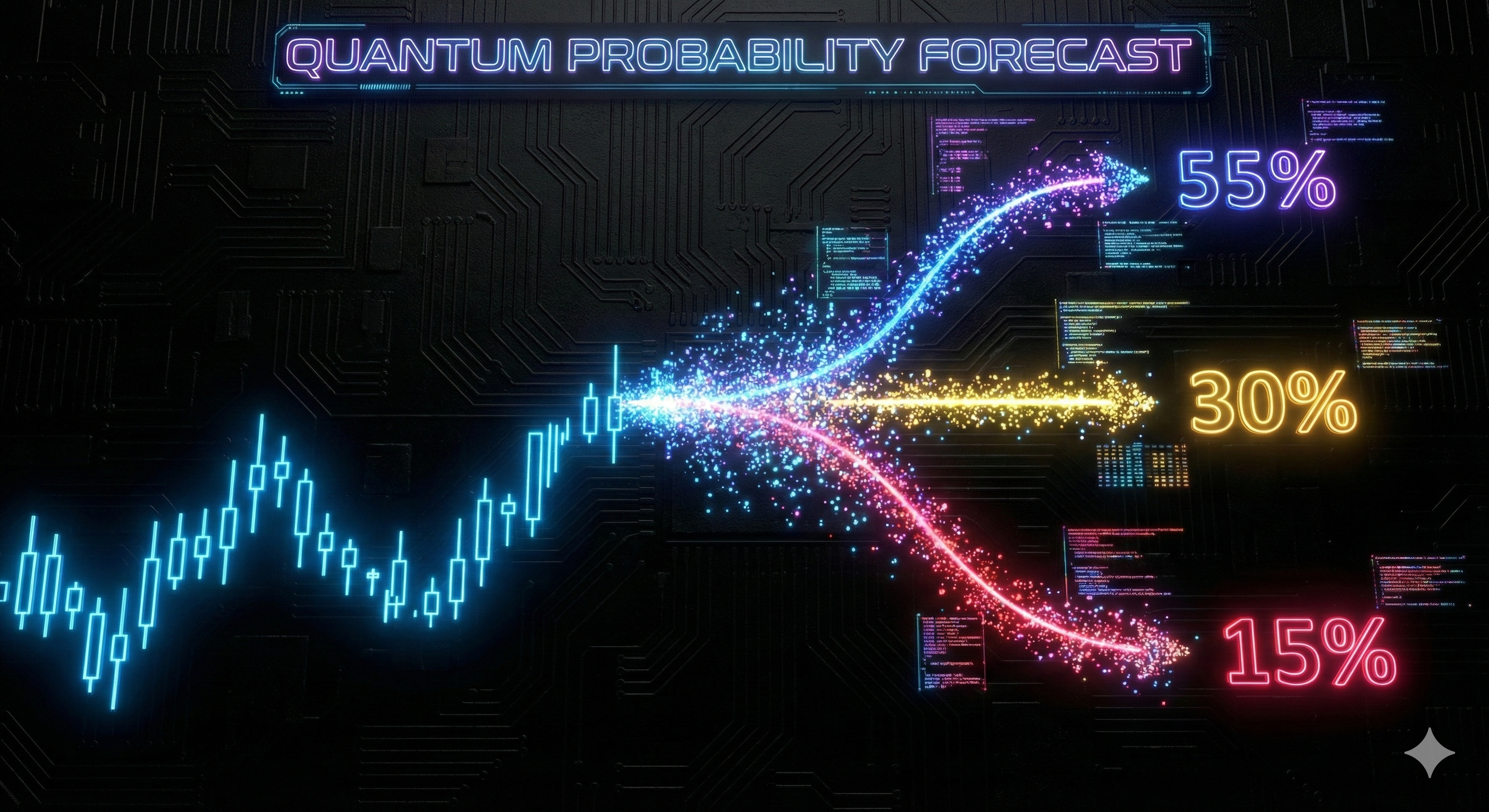
2. The Micro vs. The Macro
To understand uncertainty, we must distinguish between the Micro (one trade) and the Macro (100 trades).
The Micro Perspective
On ONE trade, anything can happen. Your perfect setup can fail because one big bank decided to sell. The outcome of a single trade is essentially random.
Result: Uncertainty (Randomness)
The Macro Perspective
Over 100 trades, if your strategy has an "edge" (e.g., a 60% win rate), the law of large numbers takes over. The randomness smooths out into a predictable profit curve.
Result: Certainty (Consistency)
The amateur obsesses over the Micro ("Why did I lose THIS trade?"). The professional focuses on the Macro ("I executed my plan; the result of this specific trade is irrelevant.").
3. The Coin Flip Experiment
Let's play a game to make this concrete. I have a weighted coin. It lands on Heads 70% of the time. I'm offering you a bet.
- The Rules: You bet $10 each flip. If it's Heads, you win $20 (net +$10). If it's Tails, you lose your $10.
- The Scenario: You flip the coin. It lands on Tails. You lose $10.
Question 1: Do you feel stupid? No. You took a bet with a 70% probability of winning. The math was absolutely correct. The outcome was just the 30% minority showing up this time. That's not a mistake—that's variance.
Question 2: Do you change your strategy? Absolutely not. You flip again. And again. Because you know that over 100 flips, you'll win roughly 70 and lose roughly 30. Your expected profit is massive. Changing the strategy after one loss would be insane.
In trading, your chart setup is the weighted coin. When you take a loss on a good setup—one that met all your criteria—it is just the coin landing on Tails. It doesn't mean you were "wrong." It doesn't mean your strategy is broken. It means you paid the statistical cost of doing business. The Heads are coming. Stay in the game long enough to find them.
4. Why This is So Difficult
From the moment we are born, we are trained to associate "Loss" with "Mistake." This is hardwired into our brains through decades of conditioning:
- In school: If you get an 'F', you didn't study enough. Loss = Your fault.
- In work: If you get fired, you did a bad job. Loss = Your fault.
- In life: If you touch fire, you get burned. Loss = Your fault.
This cause-and-effect thinking works beautifully in most areas of life. But in trading, you can do everything perfectly—follow every rule, take the textbook setup, manage risk flawlessly—and still lose money. The setup was right. The execution was right. The market just didn't cooperate. That's not failure. That's probability.
This disconnect between effort and outcome drives beginners absolutely crazy. They take a loss, so their brain screams: "You made a mistake! Fix it!" So they try to "fix" their strategy. They add a filter. They change an indicator. They hesitate on the next trade. They skip the next signal because it "feels" like the last losing one.
By trying to fix something that wasn't broken, they systematically destroy their edge. They introduce randomness into a system that was designed to extract profit from randomness. The irony is brutal: the harder they try to avoid losses, the more they lose.
Accepting the Chaos
To become a profitable trader, you must surrender your need for control over outcomes. This is not weakness—it is wisdom. It is the recognition of reality.
You control your entry criteria. You control your stop loss placement. You control your position size. You control your emotional state. You control whether you follow your rules. You never, ever control whether the trade wins or loses.
Once you truly accept—not intellectually, but in your bones—that any specific trade can fail for reasons completely outside your control, something remarkable happens. Fear disappears. Hesitation vanishes. You stop second-guessing yourself.
You see a setup that matches your criteria. You calculate your risk. You place the trade. You accept that this money might be gone—and you're okay with it. Then you let the probabilities play out. Win or lose, you do the same thing tomorrow. And the day after. And the day after that. That's how professionals operate. That's how you eventually win.