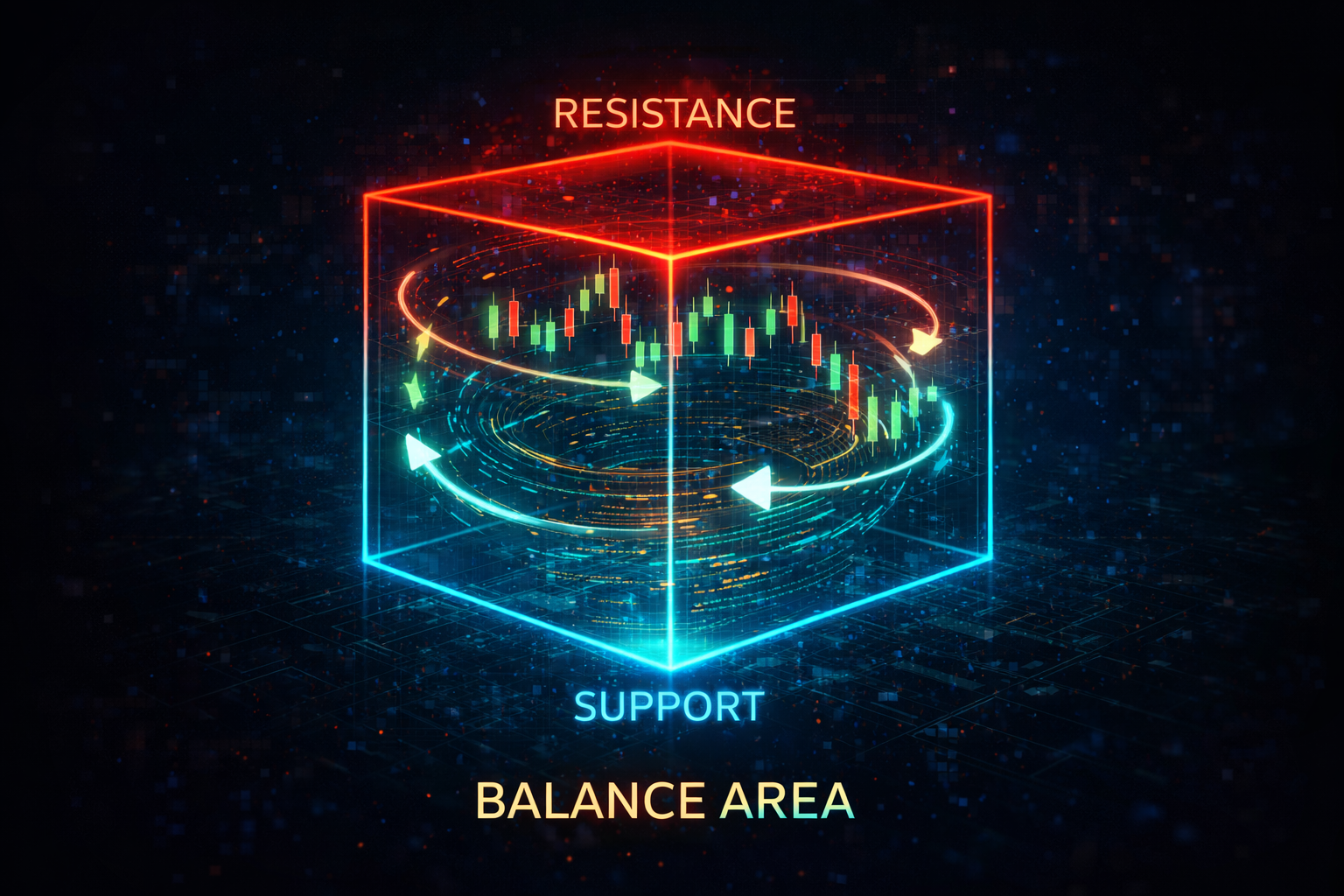
In Auction Market Theory—the framework that explains how markets discover price—the market exists in two fundamental states: Imbalance (Trending) and Balance (Ranging). When the market is in Balance, neither buyers nor sellers have overwhelming control. Price rotates around a fair value price, oscillating between "too expensive" and "too cheap" as participants negotiate equilibrium.
Think of it like a house auction. If the fair price is $500k, bidders might offer $480k (below value—cheap) or push to $520k (above value—expensive). The auction oscillates in this range as buyers and sellers feel each other out. But if someone shouts "$800k!", silence falls. That price is immediately rejected—no one agrees it represents fair value. This rejection creates the Range High. Similarly, if bidding drops to $300k, everyone jumps to buy—that's obviously too cheap. This creates the Range Low.
The Range High and Low are not arbitrary lines; they represent the boundaries where market participants collectively agree: "This is too expensive" or "This is too cheap." Understanding this psychology is crucial because these boundaries are also where massive amounts of liquidity accumulate from traders betting on the range continuing.
1. Why Ranges are Liquidity Factories
The longer a range lasts, the more explosive the eventual breakout will be. This is one of the most reliable principles in trading. Why does this happen?
Because as time passes and the range continues to hold, more and more traders pile their orders at the obvious boundaries. Each touch of the range high or low that gets rejected attracts new traders who believe the pattern will continue. They add positions and place their protective stops in predictable locations.
- Short Sellers (Range Traders): They sell every touch of the Range High, expecting mean reversion. They place their Stop Losses just above the Range High. "If price breaks above, my thesis is wrong."
- Long Buyers (Range Traders): They buy every touch of the Range Low, expecting a bounce. They place their Stop Losses just below the Range Low. "If price breaks below, I'm out."
- Breakout Traders (Waiting): They're sitting on the sidelines, waiting for the range to end. They place Buy Stop orders above the High ("I'll buy the breakout!") and Sell Stop orders below the Low ("I'll short the breakdown!"). These pending orders become market orders the instant price touches them.
This creates massive pools of liquidity resting on both sides of the range—above and below. The longer the range persists, the larger these pools grow. The market is like a coiled spring, storing potential energy with each passing day. When the range finally breaks, all that stored energy releases at once, creating the explosive moves that follow long consolidations.
2. Behavior at Range High (The Ceiling)
When price approaches the Range High, we watch for three specific scenarios:
The Rejection
Price touches the level and immediately sells off. Sellers are defending aggressively. Valid short.
The Deviation (SFP)
Price spikes above, grabs liquidity, then closes back inside. Best setup. It traps breakout traders.
The Acceptance
Price breaks above, pulls back, and holds above the level. The Ceiling has become the Floor. The range is over.
3. The "Power of 3" (AMD)
This is a critical institutional concept that explains how ranges typically resolve. AMD stands for Accumulation, Manipulation, Distribution—three phases that often play out in sequence within ranging markets.
- Accumulation: This is the range itself. Smart Money is quietly building positions over time, absorbing retail selling at lows and retail buying at highs. The range looks boring and frustrating to day traders, but it serves a purpose: it allows large players to accumulate (or distribute) massive positions without significantly moving the price. The longer this phase lasts, the larger the position being built.
- Manipulation: Before the real move begins, there's usually a false breakout—the Stop Hunt. If Smart Money has been accumulating for a bullish move, they will often push price below the Range Low first. This triggers all the buy-side stop losses (creating sells for them to buy) and tricks breakout traders into shorting (providing even more liquidity). This phase is designed to shake out weak hands and trap counter-trend traders.
- Distribution: The real move. After collecting liquidity via the Manipulation phase, price explodes in the intended direction. In our example, price breaks above the Range High and trends strongly upward. The sellers who got trapped short during the manipulation phase are now forced to cover (buy), adding fuel to the rally. This is where the explosive, trending move occurs.
Understanding AMD helps you anticipate false breakouts. When a range finally breaks, don't assume it's the real move immediately. Watch for signs of manipulation—especially if the break goes against the higher timeframe trend.
4. Trading the Rotation
When the range holds—whether through clean Rejection or through a Deviation (sweep) that reclaims—the high-probability trade targets the Opposite Side of the range.
If you short after a Range High Deviation (price spikes above the high, sweeps stops, then closes back inside), your first Take Profit target is the Mid-Range (Equilibrium/Fair Value), and your final target is the Range Low liquidity pool on the opposite side. This gives you a clear, logical profit objective based on the market's natural behavior.
Important mindset: Do not try to hold for a breakdown through the Range Low unless the higher timeframe structure supports a bearish move. Take the easy, high-probability money inside the range. Range trading is about collecting consistent profits from the rotation, not about catching the eventual breakout (which is harder to time).
Summary
Range Highs and Lows are not impenetrable walls; they are tests. Each time price approaches a range boundary, the market is essentially asking a question: "Is there value out here? Has something changed that justifies prices beyond this range?"
If the answer is No (shown by Rejection or a Deviation that fails to hold), price rotates back toward the opposite boundary. If the answer is Yes (shown by Acceptance—price breaks out, retests, and holds), the range is over, and a new trending phase begins.
Your job as a trader is to wait for the market's answer, not to guess it. Let the deviation happen. Let the stop hunt play out. Watch how price closes. Then position yourself accordingly. This patient approach turns the chaos of range boundaries into systematic, repeatable trading opportunities.