Forex (Foreign Exchange) is not about companies. It is about countries. When you trade Forex, you are betting on the economic strength, political stability, and monetary policy of one nation versus another. This is macro-economics in its purest form.
Unlike stocks, which trade on centralized exchanges like the NYSE or Nasdaq, Forex has no "Central Exchange." It is a decentralized network of banks, institutions, and brokers (the Interbank Market) that operates 24 hours a day, 5 days a week. When Tokyo closes, London opens. When London closes, New York takes over. The market never sleeps—it simply rotates around the globe following the sun.
This decentralized structure creates both opportunities and challenges. Liquidity is virtually unlimited during major sessions, but execution quality depends heavily on your broker. Understanding these dynamics is essential before you commit real capital.
1. The Concept of "Pairs"
This is the first mental hurdle for traders coming from stocks or crypto. In stocks, you buy Apple. You pay cash, you get the stock. Simple transaction. In Forex, you are always buying one currency and selling another simultaneously. Every trade is a relative bet—you're not saying "the Euro will go up," you're saying "the Euro will outperform the Dollar."
Example: EUR/USD Price = 1.1000
EUR = Base Currency (The asset you are trading).
USD = Quote Currency (The money you pay with).
This means 1 Euro costs 1.10 US Dollars. If you "Buy EUR/USD", you are buying Euros and selling Dollars. You profit if the Euro gets stronger OR if the Dollar gets weaker.
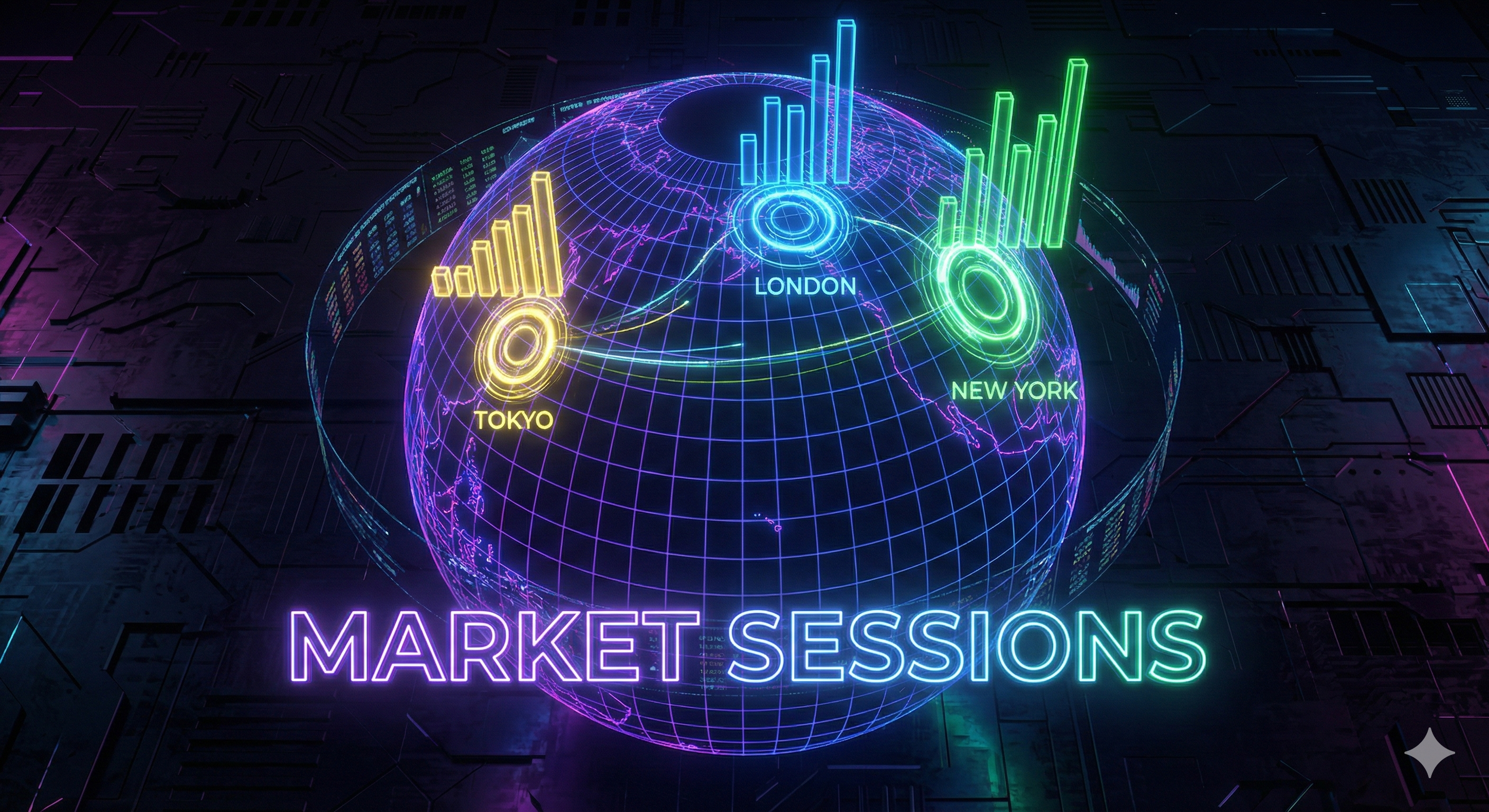
2. The Three Major Sessions
Forex is open 24/5, but it is not active 24/5. Liquidity moves around the globe like the sun. You must know when to fish.
Asian Session
Tokyo / Sydney.
Usually slow, range-bound. Good for "scalping ranges" but bad for big trends (unless you trade JPY pairs).
London Session
The Beast.
The biggest volume hits here (35% of daily volume). Trends often start here. Beware of the "London Open" fake-out.
New York Session
The Overlap.
When London and NY are both open (8 AM - 12 PM EST), volatility is insane. This is prime time for day traders.
3. Pips and Leverage
Currencies don't move much compared to stocks or crypto. A 1% daily move in EUR/USD is considered huge—equivalent to a stock moving 20% or Bitcoin moving 10%. This low volatility is why Forex traders use leverage.
What is a Pip?
Pip stands for "Percentage in Point" (or "Price Interest Point"). It is the smallest standard unit of price movement in Forex, usually the 4th decimal place (0.0001). If EUR/USD moves from 1.1000 to 1.1001, that is 1 Pip. For JPY pairs, a pip is the 2nd decimal place (0.01) because the Yen is valued much lower than other major currencies.
The Double-Edged Sword of Leverage
To make meaningful money on tiny pip movements, you need position size. Brokers allow you to trade with borrowed money—this is called leverage. With 1:100 leverage, your $1,000 account controls $100,000 worth of currency. A 50-pip move is now worth $500 instead of $5.
This sounds amazing until you realize it works both ways. Leverage amplifies losses exactly as much as it amplifies gains. Many beginners are attracted to offshore brokers offering 1:500 leverage, not understanding that this is effectively a tool for rapid account destruction.
4. The Macro Engine (News)
Stocks have Earnings reports. Forex has Economic Data releases.
In Forex, you are trading against Central Banks—the Fed (US), ECB (Europe), BOJ (Japan), BOE (UK). These institutions control the "price of money" via Interest Rates. Higher interest rates attract foreign capital seeking yield, strengthening the currency. Lower rates do the opposite.
Key economic events every Forex trader must track:
- NFP (Non-Farm Payrolls): The US Jobs report, released the first Friday of each month. Creates massive volatility as it signals economic health and influences Fed policy.
- CPI (Consumer Price Index): Measures inflation. If inflation is high, Central Banks typically raise rates to cool the economy, which strengthens the currency.
- FOMC (Federal Open Market Committee): When the US Federal Reserve announces rate decisions or provides forward guidance, the entire world listens. A single sentence from the Fed Chair can move markets hundreds of pips.
- GDP (Gross Domestic Product): The broadest measure of economic health. Strong GDP growth typically supports a stronger currency.
Professional Forex traders keep an economic calendar open at all times. Trading through major news releases without understanding the risks is gambling, not trading.
Summary
Forex is the largest, most liquid market on Earth. The sheer volume makes it nearly impossible for any single player to manipulate major pairs, which means technical analysis tends to work well. Trends can last for months or even years as countries go through economic cycles.
However, Forex demands respect for the macro environment. You are not trading chart patterns in a vacuum—you are trading the relative strength of entire economies. Ignoring central bank policy, economic data releases, and geopolitical events is a recipe for disaster. And leverage, while necessary to profit from small price movements, must be managed with extreme discipline. More retail accounts are destroyed by excessive leverage than by bad trade selection.
Forex rewards the patient, macro-aware trader who understands that currencies move for fundamental reasons and uses technical analysis to time entries and exits within that larger context.